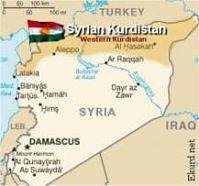


ERBIL, Kurdistan Region -- The Free Syrian Army (FSA) is accusing members of the Kurdistan Workers’ Party (PKK) of hindering their movements against the regime of Bashar Assad. But leaders of the Democratic Union Party (PYD), a PKK affiliate that yields influence in the Kurdish areas of Syria, say they are determined to stop the revolution and bloodshed from reaching the Kurdish cities.
The Kurds of Syria have largely avoided the anti-Assad uprising that started last March and so far claimed more than 15,000 lives. Nuri Brimo, a senior member of the Kurdistan Democratic Party of Syria told Rudaw that the Kurdish National Council (KNC) has not engaged the Syrian regime in any clashes because they want to keep the Kurdish areas peaceful.
“We did not want the events of Daraa and Homs repeated in Kurdish cities," Brimo said. "One day things will get out of control, but until now security has prevailed and nothing major has happened so far to disturb it." However, earlier this month Kurdish areas witnessed violent clashes between members of the KNC and the PYD until both groups signed an agreement in Erbil on June 11 to end their hostilities.
Hussein Kocher, PYD’s representative in the Kurdistan Region, believes a security gap in the Kurdish areas is inevitable once the Syrian regime has collapsed.
"It is not clear what will happen after the collapse of the Assad regime,” he says. “There is already a security gap and we are trying to fill this gap.” In the meantime, the Free Syrian Army has called upon Kurdish groups to join the effort to topple the Syrian government.
Mustafa al-Sheikh, FSA chief of staff, told the Turkish newspaper Cihan that the PKK has deployed its forces in northern Syria in coordination with the Syrian regime. “The Syrian regime is trying to use the Kurds,” al-Sheikh told Cihan. “The PKK has been mobilized in Syria on orders of the regime. The Syrian regime is supporting the PKK now against the interests of Turkey. It’s necessary for the Kurds to join the FSA and work together as other nations are doing to topple this regime. This is the only way we can create a free Syria for all." Col. Riyaz Asaad of the FSA told Rudaw, "We have not asked the Kurds to join the FSA, but we asked mediators to convince Kurdish officers who deserted the Syrian army -- around 300 members -- and fled to Iraqi Kurdistan to join."
Regarding the response of these Kurdish officers, Col. Asaad said, "We have not received an answer from them yet, but I believe these officers are being threatened by armed PKK members not to join the FSA." Col. Asaad confirmed that thousands of PKK guerillas have been mobilized to the Efrin region, near the Turkish border. "The PKK guerillas are hindering the movement of our armed forces in these regions," he said.
According to Col. Asaad, the number of Kurdish soldiers in the FSA does not exceed 25. "Those are not PKK guerillas,” said PYD's representative in Erbil. “They are national defense forces. They are present in most western regions and their duty is to protect the Kurds."
Kocher admitted that "some time ago, units of the FSA wanted to enter the Efrin region but the Kurdish people did not allow them. Kurds have their own forces and do not need Arab forces or forces from any other countries." According to Kocher, the KNC and PYD are forming a Kurdish defense force for the Kurdish areas of Syria. PYD is not alone in its opposition to FSA presence in the Kurdish cities. "We also do not accept the presence of the FSA in our regions." Brimo said.
"This army (FSA) wants to deal with the Kurds as individuals. We are a nation, and if they want us to become their partners they should treat us as such," Brimo added.
http://www.rudaw.net/english/news/syria/4882.html